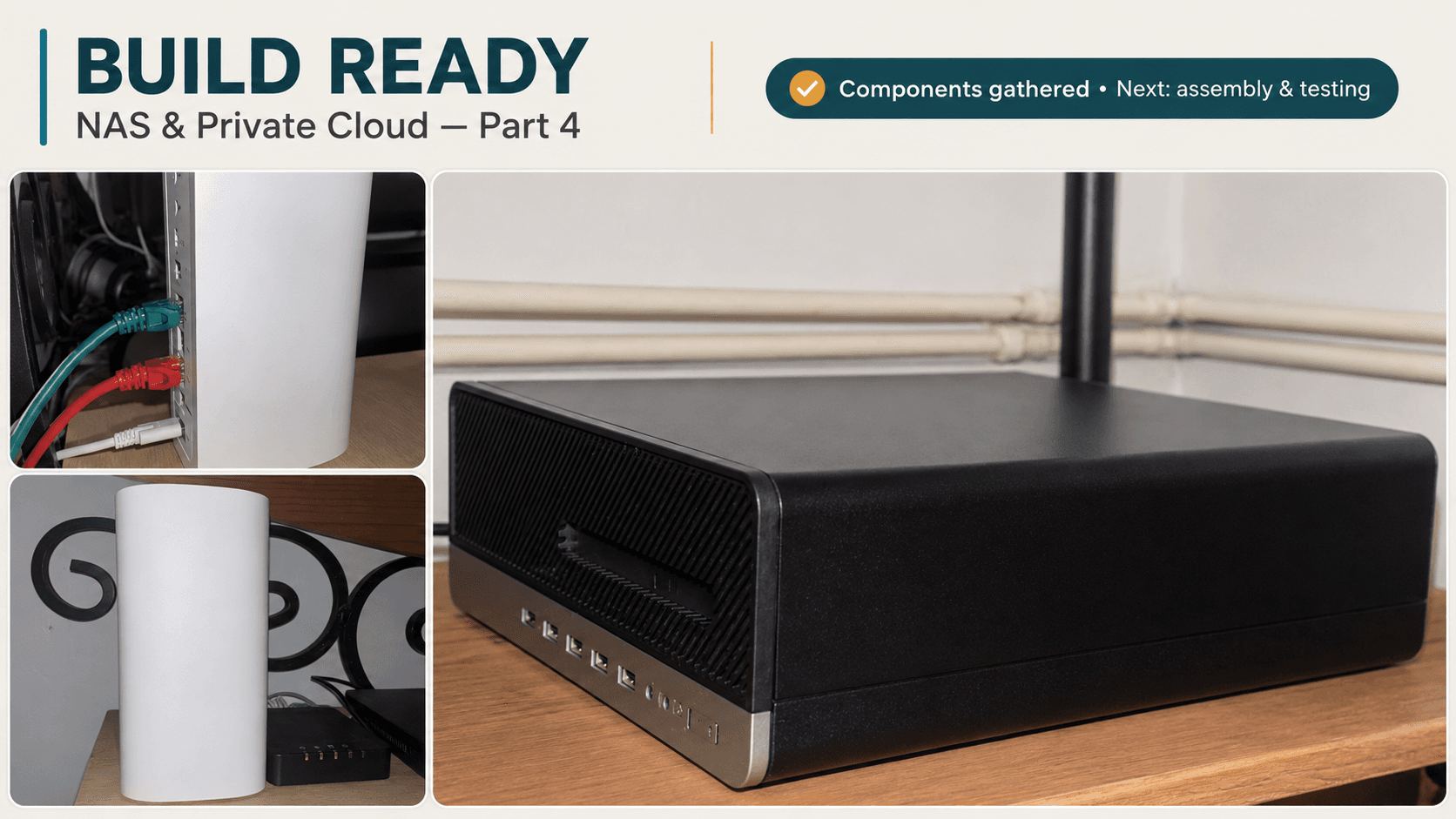
Dedicated NAS system
HP EliteDesk 800 G3 SFF
- Intel Core i5-7500 processor
- 16 GB DDR4-2666 memory (4 × 4 GB)
- Dedicated storage and remote-access role
- Selected after physical compatibility checks
A dedicated NAS and private-cloud platform with mirrored storage, controlled user access, automated provisioning, secure remote connectivity, and a portfolio-integrated Drive experience.
Public Technical Documentation
The public documentation provides a structured overview of the requirements, final hardware, ZFS storage topology, architecture, identity and access model, automated provisioning, remote connectivity, security engineering, recovery planning, monitoring, validation, operational procedures, risks, lessons learned, and future roadmap.
Credentials, tokens, private addresses, internal paths, dataset identifiers, and sensitive recovery details are intentionally excluded from the public edition.
Final Outcome
The physical build, mirrored storage, user access, provisioning workflow, remote connectivity, and operational checks have been completed. The service is live and working against the original project requirements.
Project Overview
The project began with a simple goal: create a private, Google Drive-like environment under my control. It became a complete infrastructure exercise covering hardware, ZFS, identity, automation, networking, security, monitoring, and recovery planning.
Create a private file-storage service with a familiar web experience
Provide separate authorised accounts and configurable storage quotas
Use mirrored storage to tolerate a single data-drive failure
Enable encrypted remote access without publishing the NAS administration interface
Automate user-storage provisioning and document the complete build
Hardware Design
The completed physical build uses a compact business-class system configured specifically for storage. The operating system, applications, and user data are separated, while two dedicated data drives provide mirrored capacity and single-drive fault tolerance.
Physical compatibility was treated as a design requirement
Drive bays, mounting points, SATA connectivity, power, clearance, cooling, and serviceability were verified before the final platform was commissioned.
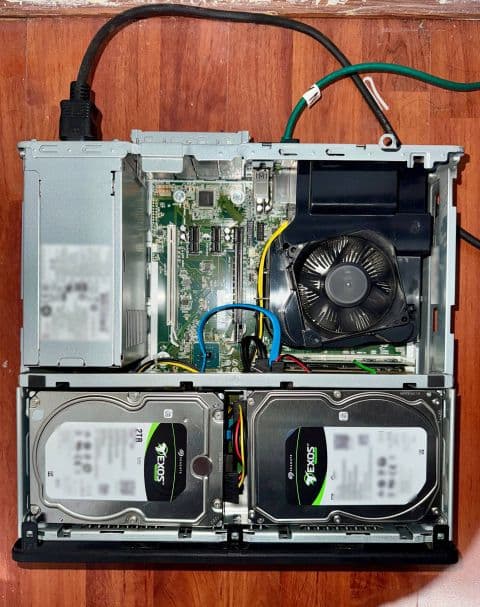
Dedicated NAS system
Primary data storage
Separated workloads
The Costliest Mistake
My first computer looked capable by processor, memory, and advertised storage specifications. A physical inspection revealed limitations in drive bays, clearance, mounting, power, SATA connectivity, airflow, and expansion. Replacing it added time and cost, but prevented an unreliable build and became one of the project's most valuable lessons.
System Architecture
The public application handles the user experience while the NAS and administration services remain separated behind controlled access and provisioning layers.
The public web application provides sign-in, account checks, and the user-facing Drive experience without exposing the TrueNAS interface.
Role and account checks restrict the service to approved users before any storage operation is permitted.
A controlled background workflow processes approved requests and provisions isolated user storage without manual service reloads.
TrueNAS manages the storage pools, datasets, permissions, applications, monitoring, and maintenance tasks.
ZFS datasets provide separated storage areas, capacity controls, and a resilient two-drive mirror for user data.
Implementation Journey
Each stage was completed and validated before the system was treated as operational.
Defined the need for private storage, remote use, individual accounts, quotas, resilience, and portfolio integration.
Compared systems, drive technologies, physical bays, SATA connections, power availability, cooling, and expansion limits.
Replaced the original computer after discovering that its internal layout could not reliably support the planned storage design.
Installed the selected components, deployed TrueNAS SCALE, verified every drive, and completed the initial system configuration.
Created the ZFS mirror, datasets, permissions, quotas, application storage, authenticated access, and provisioning workflow.
Validated storage health, user separation, provisioning, file operations, remote access, backup tasks, and monitoring before launch.
Security Approach
Public documentation remains intentionally high level. Internal addresses, identities, paths, credentials, and configuration details are excluded.
External sessions use HTTPS so credentials and file transfers are encrypted in transit.
The user-facing service remains separate from the NAS management interface and internal configuration.
Individual datasets, permissions, and quotas restrict users to their assigned storage areas.
Approved requests are processed through a restricted workflow rather than granting direct administrative access.
Replication and recovery tasks support resilience, while an independent backup remains a separate requirement.
Public documentation explains the design without exposing addresses, credentials, identifiers, or private paths.
Operational Evidence
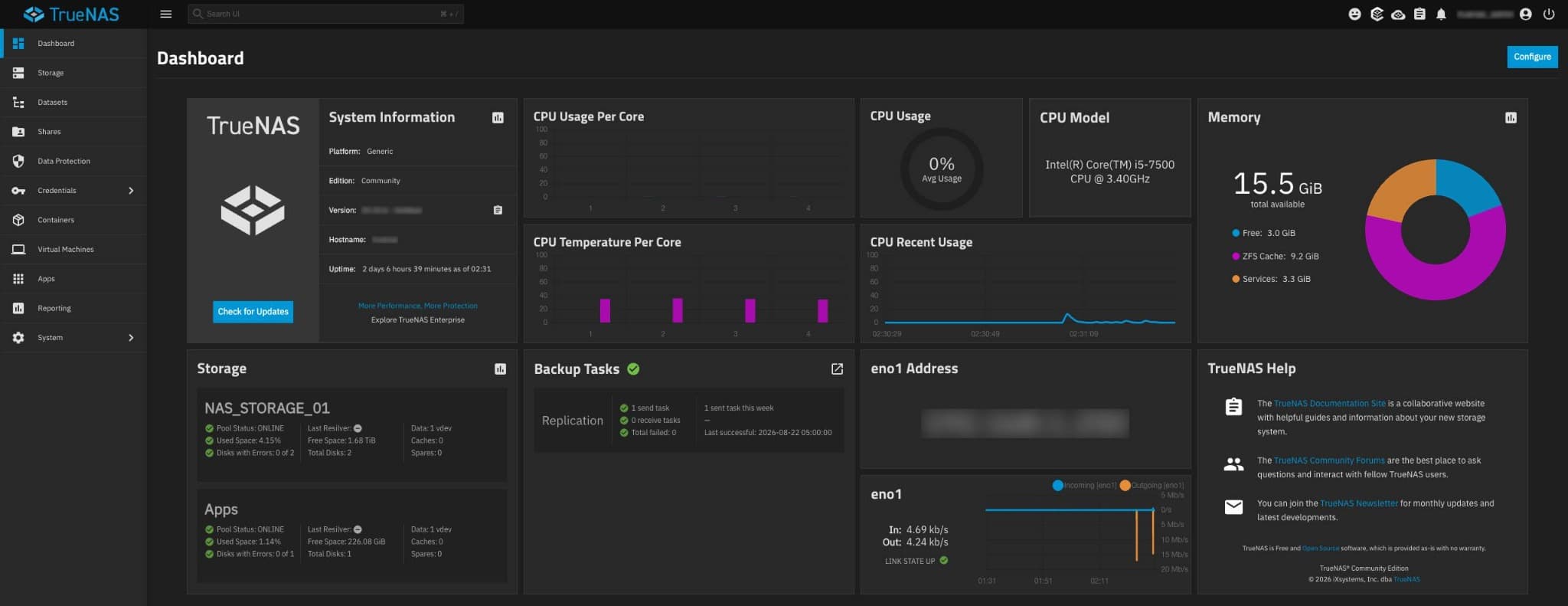
The sanitised dashboard records the final operating state while removing administrative identity, software-version, hostname, and network-address information.
Learning Outcomes
Processor and memory specifications looked suitable on the first system, but drive bays, clearance, cabling, power, and airflow determined whether it could actually become a reliable NAS.
A mirror improves availability after one drive fails. It does not protect against deletion, corruption, theft, or every system-level failure, so independent backups are still necessary.
Authentication, authorisation, encryption, user isolation, and administrative separation were treated as architecture requirements rather than additions after deployment.
Provisioning was tested across the complete workflow so new approved users could receive storage without manual reloads or inconsistent permissions.
Continuous Improvement
The platform is operational, but reliability and security require continued testing, maintenance, and documentation.
Strengthen off-system backups and test restoration regularly rather than assuming stored copies are recoverable.
Expand notifications for disk health, storage capacity, failed jobs, service availability, and unusual conditions.
Develop clearer long-term visibility into performance, capacity growth, temperatures, and service health.
Review accounts, permissions, updates, recovery procedures, and external exposure on a defined schedule.
Add UPS integration and verify graceful shutdown and restart behaviour during power interruption tests.
Keep build, maintenance, restoration, and incident procedures accurate as the platform evolves.
Project Complete
The most important outcome is not simply the storage capacity. It is the practical experience of researching, correcting mistakes, integrating systems, validating security boundaries, automating operations, and moving an infrastructure idea into reliable use. Future work will build on this foundation through stronger recovery testing, monitoring, power protection, and additional controlled self-hosted services.
View All Projects